
Trebor Healey & Arthur Tress’s ‘Navel of the Moon/Ombligo de la Luna’ - Bilingual Poetry and Photography from Mexico City

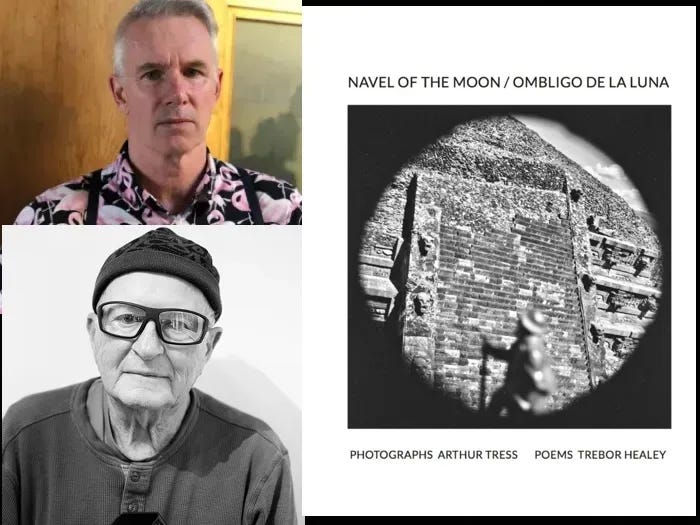
A visually rich and thoughtfully crafted collaborative work by photographer Arthur Tress and poet-novelist Trebor Healey from Mexico City, “Navel of the Moon / Ombligo de la Luna” is part travel notebook, part visual dream, and a book that feels quietly intimate. Each poem by Healey is printed in both English and Spanish, accompanied by the fine arts photography of Arthur Tress.
“Ombligo de la Luna / Navel of the Moon” is a luminous collaboration between the two artists, with introduction by Mexican playwright, filmmaker and cultural critic Victor M. Gómez Villaverde.
Although born in the United States, Healey and Tress have both lived in Mexico for several years. Their partnership is organic and synergistic. The result of their collaboration is a collection that elevates the landscape into something almost mythic.
Arthur Tress, born in Brooklyn, is a distinctive figure in staged and surreal photography. He received a Lucie Award in Fine Art. Tress describes his photographs as projections of imagination as much as records of reality, a philosophy that helps explain their dreamlike quality. His work has been collected by the Centre Pompidou, Los Angeles County Museum of Art (LACMA), and the Whitney Museum of American Art. This is his fourth book of photography.
“I am a photographer who enjoys making small surreal books of fantasy narrative. For the last few years I have rediscovered 'documentary' photography and no longer see the difference between that approach and "staged 'manipulated imagery as both are projections of the artist's awareness and imagination,” Tress says of his work.
Trebor Healey was born in San Francisco and emerged from the spoken-word and small-press poetry scenes. His published works include “Through It Came Bright Colors” (2003) and “A Horse Named Sorrow” (2012), both widely acclaimed within LGBTQ literary circles. He has won multiple honors, including the Ferro‑Grumley Award for LGBTQ fiction and the Jim Duggins Outstanding Mid‑Career Novelists’ Prize from the Lambda Literary Foundation.
“Writing is how I process the world…this book is how I am articulating all I have learned from the wonder that is Mexico. It has taught me something ancient and true that my own country has sought to erase,” Healey tells Adelante Magazine. “I love how the world and life just blooms/explodes in Mexico. I think one does find oneself in the resonance of the real these places echo and evoke.” His favorite authors are Juan Rulfo and Ines Arredondo “and of course the poetry of Octavio Paz.”
The noteworthy title “Ombligo de la Luna” invokes an Aztec legend. It is the meaning of the name “Mexico” (Mēxihco) in Nahuatl: metztli (moon), xīctli (navel or center), and the suffix -co (place). The place at the navel of the moon is Tenochtitlan (Mexico City), built on an island at the center of Lake Texcoco, called “Moon Lake.” The spot selected by the god Huitzilopochtli when an eagle on a cactus was seen eating a snake. Centuries later, the symbol was selected as the national emblem of Mexico.
Throughout the full-sized art book, the moon is a recurring theme as witness, metaphor, dream symbol, serene companion above the sprawling city. Like the book itself, it invites more questions than answers.
The extraordinary within the ordinary
What makes “Navel of the Moon” distinctive is its focus on the extraordinary within the ordinary, and other everyday contradictions. Healey’s unadorned poems tend to be relatively spare, allowing for reflection as understatement conveys the emotional meaning of captured moments.
While Tress’s photos do not seek to illustrate the poems, words and pictures definitely augment one another, widening the lens of perception.
The haunting poem “The Disappeared” features a photo with what looks like a billboard advertisement featuring a blindfolded mother with two blindfolded children; on a high wall off to the side there's graffiti of a slumped over middle-aged man with a large wind-up key in his back. The poem begins, “More than 100,000 from highways and school and jungles and swap meets. Where have they gone? Where can their families search?”
No longer the domain of fascist South American dictators, but now incentivized in North America by a corrupt economy steadily cannibalizing itself.
The poem “El Flaco” is paired with a photo of a pensive teen wearing earbuds and puffer vest, seen through a bicycle wheel. He looks like he could well be an Aztec prince stepping out of the pages of history. The poem reflects on the 15-year-old boy, el quinciañero, “But there’s no celebration / The world already belongs to him.”
‘Navel of the Moon: Arthur Tress & Trebor Healey in Visual and Poetic Collaboration,’ Blurb, $24.60
http://www.blurb.com/b/12708997-navel-of-the-moon
http://www.arthurtress.com
http://www.treborhealey.com